Research themes
Ordered structures in polymer materials
We connect polymer field theory, numerical algorithms, and experiment to understand how molecular architecture and processing conditions select ordered, aperiodic, and crystalline states.
with full-text PDFs
Theory and simulation
Field theory and numerical algorithms
We develop field-theoretic models and algorithms for polymer self-assembly in bulk, under confinement, and in multicomponent systems. High-order propagator solvers, real-space electrostatics, and phase-equilibrium methods make demanding calculations more accurate and reusable across physical models.
Our newest published approach represents polymer architectures as graphs. Graph isomorphism and hierarchical subtree decomposition identify equivalent propagators, reducing repeated work for complex noncyclic chains.
Current direction Solver acceleration, lower memory demand, and general formulations for more complex architectures and mixtures.
Selected papers
- Accelerating Field-Based Simulations of Block Copolymers by Exploring Symmetry of Chain Architectures DOI PDF
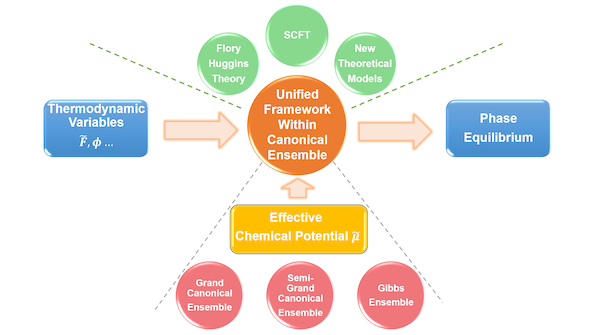
- A Unified Approach to Phase Equilibria in Multi-Component Polymer Systems with Effective Chemical Potential DOI PDF
- An Efficient Algorithm for Self-Consistent Field Theory Calculations of Complex Self-Assembled Structures of Block Copolymer Melts DOI PDF
- Exponential time differencing methods with Chebyshev collocation for polymers confined by interacting surfaces DOI PDF
- Microphase Separation and Phase Diagram of Concentrated Diblock Copolyelectrolyte Solutions Studied by Self-Consistent Field Theory Calculations in Two-Dimensional Space DOI PDF
Molecular design
Polymer architectures and phase behavior
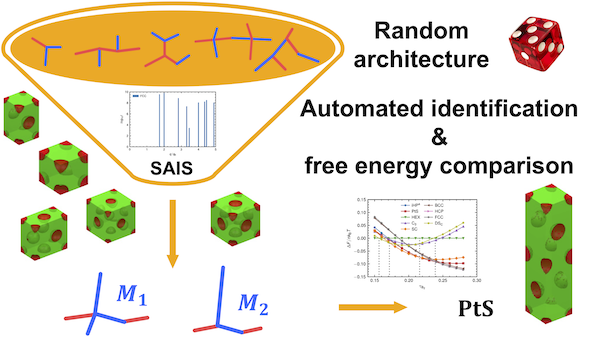
Our graph-enchand SCFT model enables treating polymer chain architectures as a design variable. We study how this architecture together with composition, conformational asymmetry, blending, and segregation compete to select structures and reorganize phase diagrams.
In our recent work, we show how to design a novel stable PtS structure by exploring the chain architecture parameter space.
Current direction Moving from prescribed architectures toward screening arbitrary architectures, multicomponent blends, and structures selected by target properties.
Selected papers
- A Unified Approach to Phase Equilibria in Multi-Component Polymer Systems with Effective Chemical Potential DOI PDF
- Automated chain architecture screening for discovery of block copolymer assembly with graph enhanced self-consistent field theory DOI PDF
- Simplicity in Mean-field Phase Behavior of Two-component Miktoarm Star Copolymers DOI PDF
- Microphase Separation and Phase Diagram of Concentrated Diblock Copolyelectrolyte Solutions Studied by Self-Consistent Field Theory Calculations in Two-Dimensional Space DOI PDF
Films and surfaces
Confinement, interfaces, and DSA
Interfaces do more than bound a polymer film: they select domain orientation, reshape free-energy barriers, and control how defects disappear. Our soft-confinement model separates surface preference from surface softness, while studies of polymer brushes identify distinct surface states across attractive and repulsive interactions.
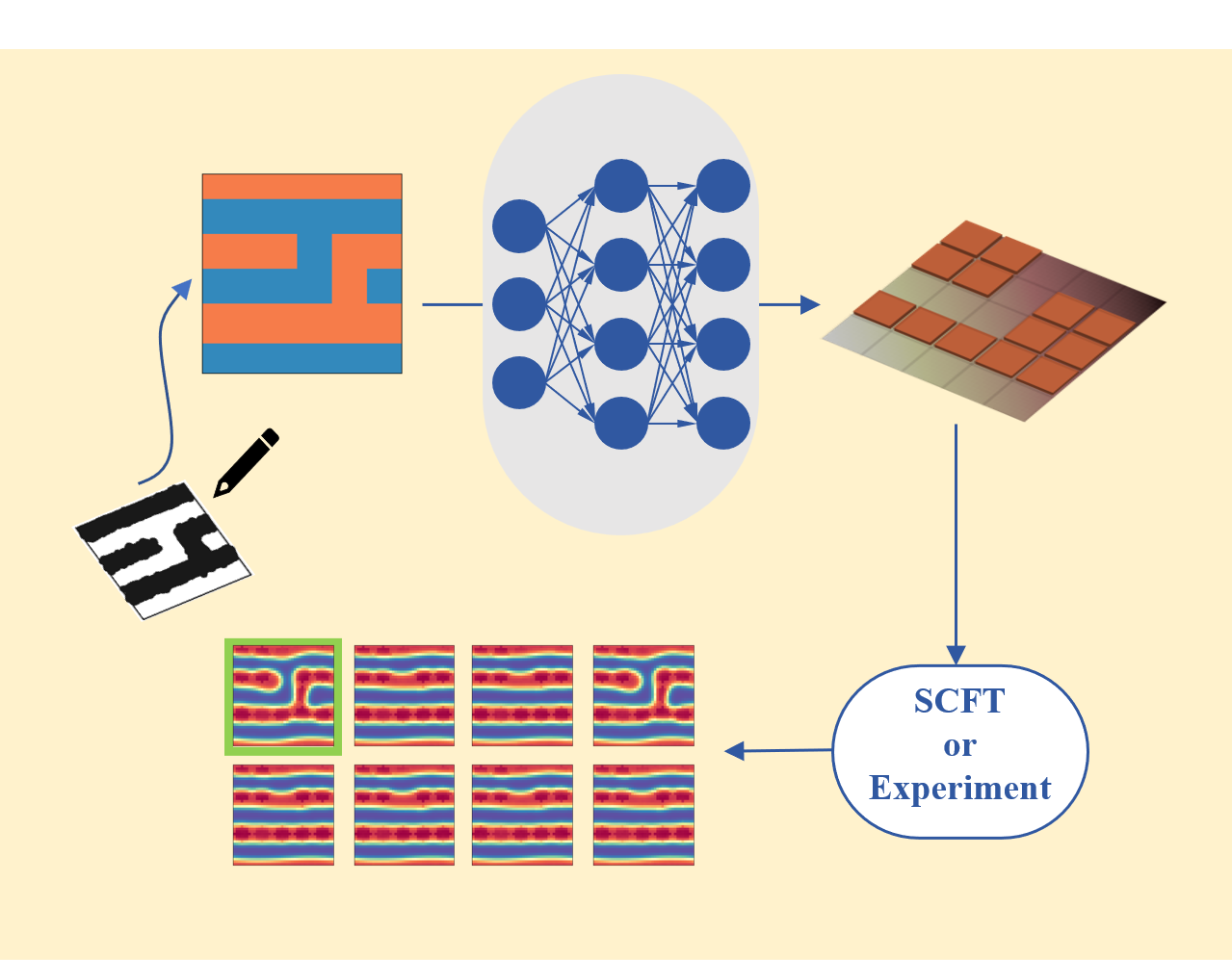
String-method calculations resolve competing pathways for removing lamellar defects. More recent work recasts directing-template design as a machine-learning problem, connecting interfacial physics with inverse design while retaining forward simulation for validation.
A complementary study of solution-processed organic films traced composition waves propagating from kinetically frozen surface mesophases during solvent evaporation.
Selected papers
- Template Design for Complex Block Copolymer Patterns Using a Machine Learning Method DOI PDF
- Composition Waves in Solution-Processed Organic Films and Its Propagations from Kinetically Frozen Surface Mesophases DOI PDF
- Removal Pathways of Out-of-plane Defects in Thin Films of Lamellar Forming Block Copolymers DOI PDF
- Theoretical Studies on Defect Removal in Block Copolymer Thin Films under Soft Confinement DOI PDF
- Structures and Surface States of Polymer Brushes in Good Solvents: Effects of Surface Interactions DOI PDF
- A Surface Interaction Model for Self-assembly of Block Copolymers under Soft Confinement DOI PDF
Beyond mean field
Fluctuations and aperiodic matter
Not every soft-matter state can be understood by mean-field theory. Complex-Langevin field simulations show how thermal fluctuations qualitatively reshape the phase diagram of miktoarm-star copolymer–homopolymer blends.
These simulations recover a fluctuation-stabilized bricks-and-mortar mesophase between microphase and macrophase separation. Near the order–disorder transition, the state is aperiodic rather than a conventionally ordered crystal.

Structure and kinetics
Polymer crystallization and hierarchical order
Ultrathin polymer films provide a real-space view of nucleation, metastability, chain folding, and lamellar crystal reorganization. In situ AFM, nucleation theory, and phase-field modeling resolved competing crystallization pathways in low-molecular-weight PEO and the nucleation-and-growth mechanism of lamellar thickening.

Selected papers
- Folded Chain Lamellae of Dynamic Helical Poly-(phenylacetylene) in Hexagonal Columnar Phase DOI PDF
- Thickening Kinetics of Monolayer Crystals of Low Molecular Weight Poly(ethylene oxide) Fractions on Mica Surfaces DOI PDF
- Phase Selection Pathways in Ultrathin Film Crystallization of a Low Molecular Weight Poly(ethylene oxide) Fraction on Mica Surfaces DOI PDF
- Polymer crystallization of ultrathin films on solid substrates DOI PDF
- Direct Observation and Modeling of Transient Nucleation in Isothermal Thickening of Polymer Lamellar Crystal Monolayers DOI PDF
Research infrastructure
Scientific software
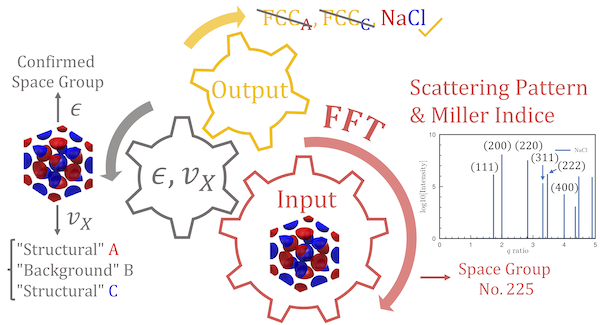
We turn models and algorithms into open, inspectable computational software/packages. Graph-based model construction, automated phase recognition, distributed architecture screening, and reusable Julia packages connect physical questions to calculations that can be repeated and extended.
Polyorder.jl is the central SCFT platform. Polymer.jl and PolymerArchitecture.jl describe chain topology; PhaseDiagram.jl handles coexistence calculations.
Current direction Integrating model definition, solvers, phase recognition, and provenance into one coherent computational environment.
Selected papers
- Accelerating Field-Based Simulations of Block Copolymers by Exploring Symmetry of Chain Architectures DOI PDF
- Automated chain architecture screening for discovery of block copolymer assembly with graph enhanced self-consistent field theory DOI PDF
- Automated Identification of Ordered Phases for Simulation Studies of Block Copolymers DOI PDF